
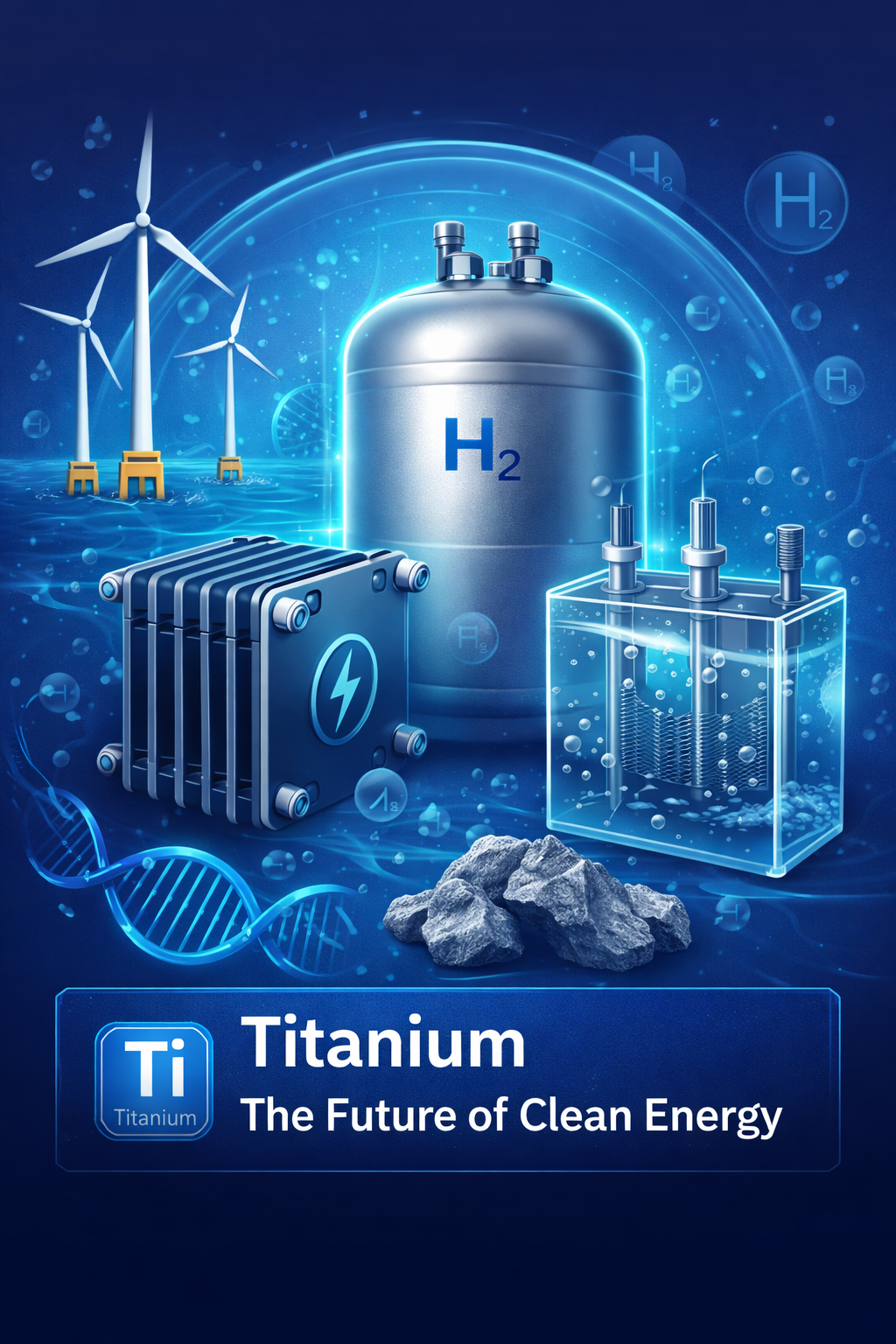
Titanium Clean Energy Technologies: Building the Hydrogen Economy
Platinum is the first metal that comes to our mind when discussing clean energy, fuel cells, batteries, and particularly hydrogen evolution via water splitting. However, using platinum in clean-tech applications is becoming more challenging due to its rising cost. In that instance, titanium, which is quickly emerging as one of the most crucial components for upcoming clean energy technologies, is effectively replacing it. It is useful and dependable for many clean-energy systems because it is robust, lightweight, and resistant to corrosion. We at Saveions think titanium’s role will only increase as the hydrogen economy grows.
Titanium’s ability to withstand corrosion in harsh conditions is one of its most valuable qualities. On its surface, titanium naturally produces a thin layer of titanium dioxide (TiO2) that keeps it protected from a harsh environment. The majority of the hydrogen production systems and fuel cells are exposed to concentrated electrolytes, harsh chemicals, high pressures, and cyclic stresses. Titanium products do not deteriorate even in passive environments due to the formation of this passive layer. Additionally, this layer prevents hydrogen embrittlement by limiting hydrogen absorption.
Titanium is emerging as a promising material for hydrogen storage
Titanium is emerging as a promising material for hydrogen storage as well. Storing hydrogen safely is becoming a major challenge today. Hydrogen atoms are very small and may penetrate other metals, leading to hydrogen embrittlement, porosity, and reduction in mechanical strength. Hence, high-pressure hydrogen cylinders, valves, and connectors designed using titanium-based alloys slow down hydrogen-induced damage much better than other materials. They maintain their ductility and strength even after prolonged hydrogen exposure. This reliability is vital for the long-term safety and performance of hydrogen infrastructure and storage. Titanium alloys are safer and more durable than many metals for high-pressure tanks, valves, and connectors used in hydrogen storage because they can withstand the damage caused by hydrogen.
The benefits of titanium extend beyond hydrogen. Its components in fuel cells can withstand moisture, gas flow, and thermal cycles without deteriorating. Its use is rising in offshore wind platforms and marine environments because in such areas corrosion is a major issue and titanium offers extremely high corrosion resistance. Metals used in such environments commonly undergo pitting corrosion and crevice corrosion, leading to the formation of pores and tiny pits within the metal structure. This weakens the metal mechanically and lead to equipment failure, safety risks, and extremely high maintenance costs. The International Titanium Association also highlights that Titanium’s corrosion resistance could make it ideal for next-generation technologies like Ocean Thermal Energy Conversion (OTEC). This shows that Titanium is not only a suitable metal for clean-energy systems but also for technologies aimed at climate restoration and sustainable energy generation.
Titanium’s high cost is still a major issue.
However, titanium’s high cost is still a major issue for its practical use despite its many advantages. Its production cost is high compared to steel and aluminum, limiting its use in daily products and applications. Therefore, the initial investment for large clean-energy systems, whether electrolyzers, fuel-cell stacks, or marine platforms, can be quite high. Economies of scale and improved manufacturing techniques may reduce costs as the demand for titanium in green technologies increases.
For companies that consider and focus on sustainability and forward-thinking solutions, such as Saveions, titanium-based products like MMO Titanium Mesh Anodes for H2, CO2, Industrial Electrolysis & Cathodic Protection, Industrial Electrolysis, Cathodic Protection, insoluble MMO titanium anode, and cathode, etc., provide a reliable, scientifically grounded foundation for developing stronger and cleaner energy systems.
Q1. Why is titanium becoming increasingly important in clean energy technologies?
Titanium offers a unique combination of corrosion resistance, mechanical strength, and low density, making it highly suitable for harsh operating environments. As clean energy systems such as electrolysers, fuel cells, and offshore renewables expand, titanium provides long-term reliability where conventional metals degrade or fail.
Q2. How does titanium compare to platinum in hydrogen-related applications?
While platinum remains an excellent catalyst, its high cost and limited availability restrict large-scale deployment. Titanium, although not a catalyst itself, serves as an exceptional structural and electrode support material. When combined with catalytic coatings, titanium enables high performance at significantly lower system-level cost.
Q3. What makes titanium resistant to corrosion and hydrogen embrittlement?
Titanium naturally forms a stable titanium dioxide (TiO₂) passive layer on its surface. This layer protects the metal from aggressive chemicals and electrolytes while limiting hydrogen diffusion into the bulk material, thereby reducing embrittlement and extending component lifetime.
Q4. Why is titanium suitable for hydrogen storage and high-pressure systems?
Hydrogen atoms can penetrate many metals, causing mechanical degradation over time. Titanium alloys maintain ductility and strength even under prolonged hydrogen exposure, making them safer and more reliable for high-pressure tanks, valves, and connectors used in hydrogen infrastructure.
Q5. What challenges limit wider adoption of titanium, and how might they be addressed?
The primary limitation is cost, driven by energy-intensive extraction and processing. However, advances in manufacturing, recycling, and economies of scale—driven by rising demand in green technologies—are expected to reduce costs and enable broader adoption across clean energy systems.